Rocket Propulsion Element - George P.Sutton

Rocket Propulsion Elements, 8th Edition
George P. Sutton (Lawrence Livermore National Laboratory. Formerly Hunsaker Professor of Aeronautical Engineering, Massachusetts Institute of Technology and formerly, Assistant to the President, Rocketdyne, a Division of Rockwell International Corporation.), Oscar Biblarz (a Professor in the Department of Aeronautics and Astronautics at the Naval Postgraduate School in Monterey, California. )
ISBN: 978-0-470-08024-5
Hardcover
784 pages
February 2010, ©2010
US $130.00


The definitive text on rocket propulsion—now revised to reflectadvancements in the field

For sixty years, Sutton's Rocket Propulsion Elements has been regarded as the single most authoritative sourcebook on rocket propulsion technology. As with the previous edition, coauthored with Oscar Biblarz, the Eighth Edition of Rocket Propulsion Elements offers a thorough introduction to basic principles of rocket propulsion for guided missiles, space flight, or satellite flight. It describes the physical mechanisms and designs for various types of rockets' and provides an understanding of how rocket propulsion is applied to flying vehicles.

Updated and strengthened throughout, the Eighth Edition explores:

  • The fundamentals of rocket propulsion, its essential technologies, and its key design rationale

  • The various types of rocket propulsion systems, physical phenomena, and essential relationships

  • The latest advances in the field such as changes in materials, systems design, propellants, applications, and manufacturing technologies, with a separate new chapter devoted to turbopumps

  • Liquid propellant rocket engines and solid propellant rocket motors, the two most prevalent of the rocket propulsion systems, with in-depth consideration of advances in hybrid rockets and electrical space propulsion

Comprehensive and coherently organized, this seminal text guides readers evenhandedly through the complex factors that shape rocket propulsion, with both theory and practical design considerations. Professional engineers in the aerospace and defense industries as well as students in mechanical and aerospace engineering will find this updated classic indispensable for its scope of coverage and utility.

PREFACE.

1 Classification.

1.1. Duct Jet Propulsion.

1.2. Rocket Propulsion.

1.3. Applications of Rocket Propulsion.

References.

2 Definitions and Fundamentals.

2.1. Definitions.

2.2. Thrust.

2.3. Exhaust Velocity.

2.4. Energy and Efficiencies.

2.5. Multiple Propulsion Systems.

2.6. Typical Performance Values.

Problems.

Symbols.

References.

3 Nozzle Theory and Thermodynamic Relations.

3.1. Ideal Rocket.

3.2. Summary of Thermodynamic Relations.

3.3. Isentropic Flow Through Nozzles.

3.4. Nozzle Configurations.

3.5. Real Nozzles.

3.6. Nozzle Alignment.

Problems.

Symbols.

References.

4 Flight Performance.

4.1. Gravity-Free Drag-Free Space Flight.

4.2. Forces Acting on a Vehicle in the Atmosphere.

4.3. Basic Relations of Motion.

4.4. Space Flight.

4.5. Flight Maneuvers.

4.6. Effect of Propulsion System on Vehicle Performance.

4.7. Flight Vehicles.

4.8. Military Missiles.

4.9. Flight Stability.

Problems.

Symbols.

References.

5 Chemical Rocket Propellant Performance Analysis.

5.1. Background and Fundamentals.

5.2. Analysis of Chamber or Motor Case Conditions.

5.3. Analysis of Nozzle Expansion Processes.

5.4. Computer-Assisted Analysis.

5.5. Results of Thermochemical Calculations.

Problems.

Symbols.

References.

6 Liquid Propellant Rocket Engine Fundamentals.

6.1. Types of Propellants.

6.2. Propellant Tanks.

6.3. Propellant Feed Systems.

6.4. Gas Pressure Feed Systems.

6.5. Tank Pressurization.

6.6. Turbopump Feed Systems and Engine Cycles.

6.7. Rocket Engines for Maneuvering, Orbit Adjustments, or Attitude Control.

6.8. Engine Families.

6.9. Valves and Pipelines.

6.10. Engine Support Structure.

Problems.

Symbols.

References.

7 Liquid Propellants.

7.1. Propellant Properties.

7.2. Liquid Oxidizers.

7.3. Liquid Fuels.

7.4. Liquid Monopropellants.

7.5. Gelled Propellants.

7.6. Gaseous Propellants.

7.7. Safety and Environmental Concerns.

Problems.

Symbols.

References.

8 Thrust Chambers.

8.1. Injectors.

8.2. Combustion Chamber and Nozzle.

8.3. Low-Thrust Rocket Thrust Chambers or Thrusters.

8.4. Materials and Fabrication.

8.5. Heat Transfer Analysis.

8.6. Starting and Ignition.

8.7. Random Variable Thrust.

8.8. Sample Thrust Chamber Design Analysis.

Problems.

Symbols.

References.

9 Liquid Propellant Combustion and Its Stability.

9.1. Combustion Process.

9.2. Analysis and Simulation.

9.3. Combustion Instability.

Problems.

References.

10 Turbopumps and Their Gas Supplies.

10.1. Introduction.

10.2. Descriptions of Several Turbopumps.

10.3. Selection of Turbopump Configuration.

10.4. Flow, Shaft Speeds, Power, and Pressure Balances.

10.5. Pumps.

10.6. Turbines.

10.7. Approach to Turbopump Preliminary Design.

10.8. Gas Generators and Preburners.

Problems.

Symbols.

References.

11 Engine Systems, Controls, and Integration.

11.1. Propellant Budget.

11.2. Performance of Complete or Multiple Rocket Propulsion Systems.

11.3. Engine Design.

11.4. Engine Controls.

11.5. Engine System Calibration.

11.6. System Integration and Engine Optimization.

Problems.

Symbols.

References.

12 Solid Propellant Rocket Fundamentals.

12.1. Basic Relations and Propellant Burning Rate.

12.2. Other Performance Issues.

12.3. Propellant Grain and Grain Configuration.

12.4. Propellant Grain Stress and Strain.

12.5. Attitude Control and Side Maneuvers with Solid Propellant Rocket Motors.

Problems.

Symbols.

References.

13 Solid Propellants.

13.1. Classification.

13.2. Propellant Characteristics.

13.3. Hazards.

13.4. Propellant Ingredients.

13.5. Other Propellant Categories.

13.6. Liners, Insulators, and Inhibitors.

13.7. Propellant Processing and Manufacture.

Problems.

References.

14 Solid Propellant Combustion and Its Stability.

14.1. Physical and Chemical Processes.

14.2. Ignition Process.

14.3. Extinction or Thrust Termination.

14.4. Combustion Instability.

Problems.

References.

15 Solid Rocket Components and Motor Design.

15.1. Motor Case.

15.2. Nozzles.

15.3. Igniter Hardware.

15.4. Rocket Motor Design Approach.

Problems.

References.

16 Hybrid Propellant Rockets.

16.1. Applications and Propellants.

16.2. Interior Hybrid Motor Ballistics.

16.3. Performance Analysis and Grain Configuration.

16.4. Design Example.

16.5. Combustion Instability.

Problems.

Symbols.

References.

17 Electric Propulsion.

17.1. Ideal Flight Performance.

17.2. Electrothermal Thrusters.

17.3. Nonthermal Electrical Thrusters.

17.4. Optimum Flight Performance.

17.5. Mission Applications.

17.6. Electric Space-Power Supplies and Power-Conditioning Systems.

Problems.

Symbols.

References.

18 Thrust Vector Control.

18.1. TVC Mechanisms with a Single Nozzle.

18.2. TVC with Multiple Thrust Chambers or Nozzles.

18.3. Testing.

18.4. Integration with Vehicle.

Problems.

References.

19 Selection of Rocket Propulsion Systems.

19.1. Selection Process.

19.2. Criteria for Selection.

19.3. Interfaces.

References.

20 Rocket Exhaust Plumes.

20.1. Plume Appearance and Flow Behavior.

20.2. Plume Effects.

20.3. Analysis and Mathematical Simulation.

Problems.

References.

21 Rocket Testing.

21.1. Types of Tests.

21.2. Test Facilities and Safeguards.

21.3. Instrumentation and Data Management.

21.4. Flight Testing.

21.5. Postaccident Procedures.

References.

Appendix 1 Conversion Factors and Constants.

Appendix 2 Properties of the Earth's Standard Atmosphere.

Appendix 3 Summary of Key Equations for Ideal Chemical Rockets.

Index.

George P. Sutton is a consultant for the aerospace industry. He formerly served as executive director of engineering at Rocketdyne (Rocketdyne Division of The Boeing Company, now Pratt & Whitney Rocketdyne) and as a laboratory associate at Lawrence Livermore National Laboratory.

Oscar Biblarz is a Professor Emeritus in the Department of Mechanical and Astronautical Engineering at the Naval Postgraduate School in Monterey, California.

** A lengthy one na ;)

Download Here >>>

Principle of jet propulsion and gas turbines- M.J.ZUCROW

Principle of jet propulsion and gas turbines- M.J.ZUCROW


Download Here >>

Advanced Gas Turbine Cycles

Advanced Gas Turbine Cycles: A Brief Review of Power Generation Thermodynamics
By J.H. Horlock

  • Publisher: Pergamon
  • Number Of Pages: 224
  • Publication Date: 2003-08-01
  • ISBN-10 / ASIN: 0080442730
  • ISBN-13 / EAN: 9780080442730


Book Description:

Hardbound. Primarily this book describes the thermodynamics of gas turbine cycles. The search for high gas turbine efficiency has produced many variations on the simple "open circuit" plant, involving the use of heat exchangers, reheating and intercooling, water and steam injection, cogeneration and combined cycle plants. These are described fully in the text A review of recent proposals for a number of novel gas turbine cycles is also included. In the past few years work has been directed towards developing gas turbines which produce less carbon dioxide, or plants from which the CO2 can be disposed of; the implications of a carbon tax on electricity pricing are considered In presenting this wide survey of gas turbine cycles for power generation the author calls on both his academic experience (at Cambridge and Liverpool Universities, the Gas Turbine Laboratory at MIT and Penn State University) and his industrial work .

Table Of Contents:

  • A brief review of power generation thermodynamics.
  • Reversibility and Availability.
  • Basic gas turbine cycles.
  • Cycle effeciency with turbine cooling.
  • Full calculations of plant effeciency.
  • Wet gas turbine plants.
  • The combined cycle gas turbine (CCGT).
  • Novel gas turbine cycles.
  • The gas turbine as a cogeneration plant.

Download the Book link 1

Download the Book link 2

Download the Book link 3

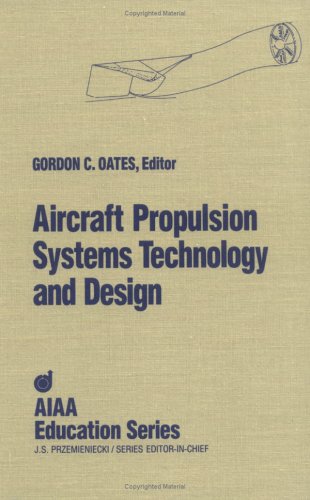
Aircraft Propulsion Systems Technology and Design


Aircraft Propulsion Systems Technology and Design
Edited by: Oates, Gordon C. © 1989 American Institute of Aeronautics and Astronautics

Description: Design and R&D engineers and students will value the comprehensive coverage in this volume, which covers all aspects of aircraft propulsion systems. STANDARD PUBLISHER DISCLAIMER - Data and information appearing in this book are for informational purposes only. AIAA and the author are not responsible for any injury or damage resulting from use or reliance, nor do AIAA and the author warrant that use or reliance will be free from privately owned rights.
Content Results
Expand this nodeFront Matter

Table of Contents

Expand this node1. Design and Development of Aircraft Propulsion Systems

Expand this node2. Turbopropulsion Combustion Technology

Expand this node3. Engine/Airframe Performance Matching

Expand this node4. Inlets and Inlet/Engine Integration

Expand this node5. Variable Convergent-Divergent Exhaust Nozzle Aerodynamics

Expand this node6. Engine Operability

Expand this node7. Aeroelasticity and Unsteady Aerodynamics


Expand this nodeSubject Index


Gas turbine theory


Gas Turbine Theory

Description

In recent years the gas turbine, in combination with the steam turbine, has played an ever-increasing role in power generation. Despite the rapid advances in both output and efficiency, the basic theory of the gas turbine has remained unchanged. The layout of this new edition is broadly similar to the original, but greatly expanded and updated, comprising an outline of the basic theory, aerodynamic design of individual components, and the prediction of off-design performance. The addition of a chapter devoted to the mechanical design of gas turbines greatly enhances the scope of the book.


Table of Contents

1 Introduction

2 Shaft power cycles

3 Gas turbine cyles for aircraft propulsion

4 Centrifugal compressors

5 Axial flow compressors

6 Combustion systems

7 Axial and radial flow turbines

8 Mechanical design of gas turbines

9 Prediction of performance of simple gas turbines

10 Prediction of performance - further topics

Appendix A - Some notes on gas dynamics

Appendix B - Problems

Appendix C - references

Index

Zum Seitenanfang

Back Cover

Gas Turbine Theory, Sixth Edition

HIH Saravanamuttoo

GFC Rogers, H Cohen, PV Straznicky

When the First Edition of this book was written in 1951, the gas turbine was just becoming established as a powerplant for military aircraft. It took another decade before the gas turbine was introduced to civil aircraft, and this market developed so rapidly that the passenger liner was rendered obsolete. Other markets like naval propulsion, pipeline compression and electrical power applications grew steadily. In recent years the gas turbine, in combination with the steam turbine, has played an ever-increasing role in power generation.

Despite the rapid advances in both output and efficiency, the basic theory of the gas turbine has remained unchanged. The layout of this new edition is broadly similar to the original, but greatly expanded and updated, comprising an outline of the basic theory, aerodynamic design of individual components, and the prediction of off-design performance. The addition of a chapter devoted to the mechanical design of gas turbines greatly enhances the scope of the book.


Descriptions of engine developments and current markets make this book useful to both students and practising engineers.

FEATURES:
· completely updated to cover current industry requirements and applications

· coverage of both aircraft and industrial gas turbines
· includes detailed treatment of off-design performance
· incorporates in-depth examples throughout
· based on the authors' extensive teaching and professional experience

Gas Turbine Theory is the classic course text on gas turbines, suitable for both undergraduate and graduate students of mechanical and aeronautical engineering. This new edition will also continue to be a valuable reference for practising gas turbine engineers.

THE AUTHORS
Herb Saravanamuttoo, Professor Emeritus, Department of Mechanical and Aerospace Engineering, Carleton University, Ottawa, Canada, has many years experience in the gas turbine industry on both sides of the Atlantic, and is a Past President of the Canadian Aeronautics and Space Institute.

The late
Gordon Rogers was Professor Emeritus of Engineering Thermodynamics at the University of Bristol. He was author, with YR Mayhew, of Engineering Thermodynamics Work and Heat Transfer, 4th edition.

The late
Henry Cohen was formerly University Lecturer and Director of Studies in Engineering at Queens’ College, Cambridge.

Paul Straznicky is Professor of Mechanical and Aerospace Engineering at Carleton University and has many years of experience as a mechanical design engineer.


Downloading >>>


Search This Blog

Followers

Labels